
I beg your pardon as I take a hiatus from the blog. I had to register for 24 credits for this semester. I found out today that the Congregation for Catholic Education (part of the Holy See) is requiring a class on Canon Law in order to graduate. So lucky me was forced to enroll in another class for the semester. That is now 27 credits. Oh, and the summer classes did not get finished over the summer. Thus, I still have the finals to complete in those courses. Thus, I am working on a grand total of 39 credits this semester. The Canon Law class will be done in 3 weeks (very intensive) and the summer courses will be done by the end of September; then it will be back to "normal" chaos. :-)
I sure would appreciate your prayers as I try desperately to keep my head above water...
Wednesday, September 05, 2007

Tuesday, August 28, 2007
Podcast on Contemplation....
 Fr. Thomas Dubay, who wrote The Fire Within and Prayer Primer: Igniting the Fire Within,among others, has presented a podcast on contemplation on EWTN. They only leave these special podcasts up for a month and you don't want to miss this one!!!
Father Dubay has written and spoken extensively on contemplation. He has studied and taught, especially, about the great Carmelite Doctors: St. Teresa of Avila and St. John of the Cross.
Here is a quote from Pope John Paul II that I hope will motivate you...
Is it not one of the "signs of the times" that in today's world, despite widespread secularization, there is a widespread demand for spirituality, a demand which expresses itself in large part as a renewed need for prayer? Other religions, which are now widely present in ancient Christian lands, offer their own responses to this need, and sometimes they do so in appealing ways. But we who have received the grace of believing in Christ, the revealer of the Father and the Saviour of the world, have a duty to show to what depths the relationship with Christ can lead.
The great mystical tradition of the Church of both East and West has much to say in this regard. It shows how prayer can progress, as a genuine dialogue of love, to the point of rendering the person wholly possessed by the divine Beloved, vibrating at the Spirit's touch, resting filially within the Father's heart. This is the lived experience of Christ's promise: "He who loves me will be loved by my Father, and I will love him and manifest myself to him" (Jn 14:21). It is a journey totally sustained by grace, which nonetheless demands an intense spiritual commitment and is no stranger to painful purifications (the "dark night"). But it leads, in various possible ways, to the ineffable joy experienced by the mystics as "nuptial union". How can we forget here, among the many shining examples, the teachings of Saint John of the Cross and Saint Teresa of Avila?UPDATE: EWTN has taken the podcast off of their website. You can find links to download it from the Into the Deep site in the comment box of this post. Thanks to Brent for putting them up!
Yes, dear brothers and sisters, our Christian communities must become genuine "schools" of prayer, where the meeting with Christ is expressed not just in imploring help but also in thanksgiving, praise, adoration, contemplation, listening and ardent devotion, until the heart truly "falls in love". Intense prayer, yes, but it does not distract us from our commitment to history: by opening our heart to the love of God it also opens it to the love of our brothers and sisters, and makes us capable of shaping history according to God's plan. Novo Millennio Ineunte #33
Saturday, August 25, 2007
Blessed Teresa of Calcutta... A bit more...
 I am reading a paper by a German theologian named Father Nobert Hoffmann. The title of the paper is: Atonement and the Ontological Coherence Between the Trinity and the Cross. Therein, he makes this statement that really strikes to heart of the issue of the 'dark night of the soul':
"The absence of the beloved, if it becomes privation and suffering, can be experienced as the painful mode of the beloved's most intense presence."Don't be too quick in rushing past this quote. It takes time, silence, and prayer to break it open. We typically don't think of another's presence in this way, and, certainly, this type of God's presence requires a deep faith because of the tendency for doubt and despair.
It seems that God asks all of those who love him to bear this type of 'presence' at differing intensities and durations. In fact, this seems to be the primary mode of experiencing God's presence within the Church Militant. It is important that we are able to recognize this type of presence as such so that we can bear it with faith and joy. There are other times when God withdraws his tangible presence for different purposes such as the consequence of serious sin.
May we think differently so that we, like Blessed Teresa of Calcutta, can learn to love the darkness...the holy darkness of faith...
Two Weeks from Today!!!!!

I am stoked! Two weeks from today the Holy Father will be in Mariazell, Austria, which is about 40 km from here. We have tickets and the entire ITI will be going. I am sure we will be a long ways away, but it will still be a very special pilgrimage at the start of the new school year.
Speaking of start of school year, I must warn my vast audience ;-) that I will not be blogging much over the next few weeks. I am finishing up the three summer courses. Unfortunately, they are going to impinge on the start of the fall semester. Whew....finishing three classes as I start six more makes my head swim! I think I have my work cut our for me.
Oh, here is my fall class schedule:
- Fides et Ratio (Faith and Reason)
- Existence and Attributes of God (St. Thomas' Summa)
- Scripture and Its Interpretation
- Patrology I (Study of Early Church Fathers)
- Latin I
- The Church in the Modern World
Blessed Teresa of Calcutta...

Please immediately go and read this article from Time on Mother Teresa. You'll have to bear up with the writer of the article and the psychologist they interviewed that simply don't get it.
The gist of the article is that a book is being published that contains personal correspondence between Mother Teresa and her spiritual directors over the years. These letters bring to light the fact that Mother Teresa suffered tremendous spiritual darkness throughout her entire life except for a couple of brief episodes. She felt completely abandoned by Christ for the majority of her life and deeply suffered, to the point of agony, because of that fact. What she models for us is what true love is: it isn't about feelings or what we get out of it. No, true love is a choice to prefer the good of the other to our own good to the point of complete sacrifice. She lived that out exteriorly and interiorly.
I think that as these letters are studied and discerned she will be one day known as one of the greatest saints in history - nearly to the place of a St. Francis of Assisi. She shows us how to love and to suffer in love and to suffer for love.
I have to admit that I fear that kind of holy darkness; goes to show how mature my relationship is with Christ (NOT MUCH). I pray that the Lord would strengthen me so I could love just a bit like she did. Furthermore, I pray that he would release from the fear and give me the courage to enter into the darkness of faith in love, confidence, and perseverance.
Don't listen to the voices that will try to shout that that proves there is no God since one who was supposedly so close to him felt abandoned by him. Her longing, her hunger, her thirst (Psalm 63), her love, her sacrifice, and her perseverance show that he was oh so close pouring his grace upon her - or she NEVER could have done it. She showed us the suffering Christ exteriorly, but also the suffering Christ in an interior fashion due to the fact that Christ experienced and suffered the separation of God from the entirety of mankind's sin he took upon himself.
She is my hero....
Blessed Teresa of Calcutta - ora pro nobis...
Tuesday, August 21, 2007
The Mountain of Temptation (con't)

As a quick reminder, all references, unless otherwise stated, are from Jesus of Nazareth...
In the previous installment, we studied Jesus' baptism in order to understand the Mountain of Temptation better. (The previous blogs are here and here.)
Following the baptism, the Gospel of Mark tells us that "the Spirit immediately drove him into the wilderness" (Mk 1:12) to be tempted. All of Jesus' temptations strike at the heart of his mission and what is truly important in human life. Ratzinger:
At the heart of all temptations...is the act of pushing God aside because we perceive him as secondary, if not actually superfluous and annoying, in comparison with all the apparently far more urgent matters that fill our lives. p. 28
He continues:
Moral posturing is part and parcel of temptation. It does not directly invite us to do evil...it pretends to show us a better way, where we finally abandon our illusions and throw ourselves into the work of actually making the world a better place...It claims, moreover to speak for true realism: What's real is what is right there in front of us - power and bread...God is the issue: Is he real, reality itself or isn't he? Is he good, or do we have to invent the good ourselves?...What must the Savior of the world do or not do? p. 28-29
All the temptations of Jesus come down to this: the bread, the pinnacle of the temple, and the high mountain are are temptations to use wealth and power to bring about a "kingdom" that makes sense to us but denies the primacy of God.
The devil approaches Jesus on this mountain to cause him to compromise his mission (and his very self) as the Messiah and the Suffering Servant by choosing the way of a political messiah by ruling through power and wealth. Ratzinger relates that this choice, between a worldly messiah (who rules through power and bread) and the true, "other-worldly" Messiah (who rules through the self-emptying and suffering of the Cross), was offered to the crowd in front of Pilate. Jesus, the Son of the Father, on one side with Barabbas, which means the "son of the father", on the other (cf. p.41). The one Messiah that rules through taking upon himself the sins of the world in humble surrender and sacrifice and the other a pseudo-messianic insurrectionist that rules through the sword and hatred.
Who will we choose? What kind of Savior did we expect? Couldn't have Jesus fed the world? Isn't that the most important thing? Isn't "justice" the one and only thing that Jesus came to bring? We all know who we chose. We crucified the Holy One of Israel and celebrated the one who brings us power and bread.
The tempter is not so crude as to suggest to us directly that we should worship the devil. He merely suggests that we opt for the reasonable decision, that we choose to give priority to a planned and thoroughly organized world, where God may have his place as a private concern but must not interfere in our essential purposes. (emphasis mine) p. 41
Thus, the Mountain of Temptation is where we too must decide whom we will choose. How often do we pick the stable, sensible way! How often do we choose to "rule" by power rather than by love! How often do we push aside God for what is easy and expedient! We speak of "justice" all the while rejecting the One who is Just. Case in point: the concern of the first world Church for feeding the poor, healing the sick, and solidarity. These are fine things in themselves, but when is the last time that Evangelization was seriously spoken of in the context of justice? Jesus, Himself, did not heal everyone in any particular town but moved on to preach the coming kingdom! The sick of Capernaum were searching for him. Jesus responded to Peter's plea:
"Every one is searching for you." And he [Jesus] said to them, "Let us go on to the next towns, that I may preach there also; for that is why I came out." Mk 1:37-38
Our position must be one of docility and obedience just as was Jesus'. We must do what he asks of us, which may go against everything we hold by worldly "common sense".
The Mountain of Temptation asks each of us the question, "Do you trust God?" Do we trust God to provide our daily bread and the bread of the world. Do we trust God to protect us? Do we require from God a proof of his Divinity? Who will we choose: God or ourselves? Our ways or his ways?
The way off this mountain is to trust God completely; that what he says is true because he says it. It is the path of loving, self-sacrifice. It is the path that seeks to give oneself to God first and foremost before undertaking the work that God calls us to. It is the narrow path leading to life through self-emptying, forgiveness of those that hurt us, and love for our enemies. It is the path of union with God and communion with our neighbor.
Wednesday, August 15, 2007
Saturday in Vienna...
Last Saturday we had the wonderful blessing of going to Vienna. Our next door neighbor if the Student Life Director here for Franciscan and gives tours of Vienna to the FUS students. They offered to take us on the tour. The trains have a special deal that we all could ride to Vienna and back for €28. That is cheaper than the gas to get there. Once there, we toured Old Vienna near the Hapsburg. It was incredible. We went to an outdoor market that every kind of fruit and spice imaginable and then some. We were able to visit several churches. The highlight was the Archdiocesan cathedral - St. Stephen's. There was a place on the outside of the church was there was an etching of the number "05" right into the stone. It was the place where the Austrian resistance would meet to exchange information. Also, the history of the Moorish invasions and the threat that was to the Austrians was palpable. Anyway, it was a fantastic day. Here are some pictures...

This is the main entrance to St. Stephens.

This is the main tower of St. Stephen's. We weren't sure why the church was so dirty. I've heard it has to do with the type of rock they used.

The side of St. Stephen's.

This is St. John Capistrano killing a Turk. He preached a crusade to save Christian Europe in the 15th Century.

Some of the many horse carriages willing to take you around Vienna.

Inside St. Stephen's. Sorry, it is dark in there!

St. Stephen's side altar.

Zach's favorite place in Vienna! ;-) We laughed about this forever, and, yes, there was Mozart coming from the toilet! (The sign says, "Opera toilet with music.")

Mozart.

The boys standing in the Swiss gate. The chapel for the Vienna boys choir is through the gate and to the right.

St. Michael's church.

Side altar at St. Michael's.

St. Augustine's church. Most of the Hapsburg family were married here. Many of the deceased Hapsburgs have hearts interred here.
It was an exhausting day but SO amazing to see the history. Vienna is a fantastic city. I hope we can get back and explore some more!
Wednesday, August 08, 2007
The Mountain of Temptation
 Whooops. I made a terrible blogger's error. I assumed that people would have read the post prior (and related) to this one explaining this series I am doing. Bad Blogger!! I apologize. The references below are all from Ratzinger's book Jesus of Nazareth. See this blog to understand what I am attempting here. Again, sorry for any confusion.
Before we begin the ascent of the Mountain of Temptation it is important to remember where Jesus is immediately coming from, viz., his baptism. It was a moment of tremendous importance for Jesus' life. He had just spent the prior 30 or so years in quiet, humble obedience to Mary and Joseph as he "increased in wisdom and in stature , and in favor with God and man" (Luke 2:52). Now he has been called to his public ministry: at once the Anointed One (Messiah) and ultimately the Suffering Servant. His entrance into public life is an entrance into the life of the world. We have to keep in mind that nothing in Jesus' life was accidental; it was a completely intentional life. Jesus willed his life in complete submission to his Father's will. So often life happens to us and we react to life rather than respond. We are scattered and dull; thus, so much escapes us. Not Jesus, however. He was drawn by the Father's will to the Jordan where John the Baptist was baptizing there for the forgiveness of sins. John was the "voice crying out in the wilderness: Prepare the way of the Lord, make his paths straight" (Matthew 3:3). John was baptizing at the Jordan one day when the unthinkable happened; He - the One who would baptize with water and Spirit came to be baptized!!
John would have prevented him, saying, "I need to be baptized by you, and do you come to me?" But Jesus answered him, "Let it be so now; for thus it is fitting for us to fulfill all righteousness." Then he consented. And when Jesus was baptized, he went up immediately from the water, and behold, the heavens were opened and he saw the Spirit of God descending like a dove, and alighting on him; and lo, a voice from heaven, saying, "This is my beloved Son, with whom I am well pleased." Matthew 3:14-17
Ratzinger tells us that the word "righteousness" here is to mean: "an unrestricted Yes to God's will and an obedient acceptance of his yoke" (p. 17). He continues on to make a very important point. This act was Jesus, already, identifying himself with sinners by taking their sins upon himself and then into the waters of the Jordan thereby anticipating the Cross as the Suffering servant:
Jesus loaded the burden of all mankind's guilt upon his shoulders; he bore it down into the depths of the Jordan. He inaugurated his public activity by stepping into the place of sinners. His inaugural gesture is an anticipation of the Cross (p.18)
The Old Testament Scriptures tell us this about the Suffering Servant (there are four Suffering Servant songs. Isaiah 42:1-7; 49:1-6; 50:4-9; 52:13-53:12):
But he was wounded for our transgressions, he was bruised for our iniquities; upon him was the chastisement that made us whole, and with his stripes we are healed. All we like sheep have gone astray; we have turned every one to his own way; and the LORD has laid on him the iniquity of us all...Yet it was the will of the LORD to bruise him; he has put him to grief; when he makes himself an offering for sin, he shall see his offspring, he shall prolong his days; the will of the LORD shall prosper in his hand; he shall see the fruit of the travail of his soul and be satisfied; by his knowledge shall the righteous one, my servant, make many to be accounted righteous; and he shall bear their iniquities. Therefore I will divide him a portion with the great, and he shall divide the spoil with the strong; because he poured out his soul to death, and was numbered with the transgressors; yet he bore the sin of many, and made intercession for the transgressors. Isaiah 53:5-6, 10-12
Thus, we see in Jesus first public action an embracing of the Father's will in its fullness: the Messiah, the Anointed One, the King will rule through the depths of self-emptying love which takes on Itself the entirety of human sin and misery. An understanding of Jesus' baptism, where he is the Anointed Messiah and takes upon himself our sin, is crucial in understanding the Mountain of Temptation. Ratzinger states:
The conclusion of the baptismal scene tells us that Jesus has received this true "anointing", that he is the Anointed One - that at that moment kingly and priestly dignity were formally bestowed on him for all time in the presence of Israel." p. 26
What can we see in this that relates to our own life? First, that when we are baptized we are baptized into the death of the Lord, and, as we come up from the waters, we come up into his Resurrected Life. We, too, anticipate our Crosses in life as we are plunged into the baptismal waters that at once bring death and give life (Cf. Catechism of the Catholic Church #1227). Thus, we must accept and even embrace the Cross; for Christianity ceases to exist without the Cross. Second, we are anointed as "little Christ's". The term "Christian" primarily means "anointed". Hence, we share in the Christ's Messianic mission to go and preach the Good News (Gospel) to the world. We are anointed by the Holy Spirit to go forth in power and charity into the world. Third, if we share in the anointing we must also share in the other aspect of the Messiah - the suffering servant. The suffering and sacrifice that is constitutive to charity we must not shrink from but embrace it as he did. We do this only through the power of God imparted to us through the grace received by our anointing. It is love and obedience to the end, the royal road that Jesus showed us, that will please the Father and bring about the Reign of God. Last, we must lay down our pride and allow God to call us to where he might. It didn't make sense that Jesus, the Perfect One, should be baptized - even to John. Jesus obeyed and so must we. All too often we ignore the promptings of the Holy Spirit because it does not fit into our perceptions of what God should or shouldn't call us to. We must be open and willing to follow Christ wherever, whenever, and however he calls...
Next time, we will ascend the Mountain of Temptation and see that Jesus' temptations are ordered to his mission as Messiah, and if it is the case for him, then it is the case for us.
Monday, August 06, 2007
Happy Feast of the Transfiguration!!
 It is hard to imagine that it has been a year! Yep, that is right. We arrived in Gaming exactly one year ago today. Time can go by so fast and so slow over the same magnitude of time. There have been days that seem they might never end and so many that have flown by.
Today, we can certainly say with Peter that it is good to be here. I am constantly amazed at the gifts the Lord gives us. It is a day to be grateful - in the present, for the blessings of being in Gaming; and deep in the past, where Christ Jesus revealed his glory to Peter, James, and John on the mountain and even more for the revealing of himself on the Cross.
God is so good to us that on the day we remember the Transfiguration of the Lord we get to see him Transubstantiated before us in the Holy Mass and, in fact, get to receive him so that we might be in union with him.
Friday, August 03, 2007
Upside-down world...
While I was in Meridian, I gave a talk titled Prepare the Way of the Lord; Make Straight His Paths (See here). You can download or listen to the talk in its entirety at www.friendsofmikelee.org. The slides I used are available there for download in .pdf format, also. The thesis of this talk was that Jesus came to turn values, ethics, and human existence upside-down. In other words, he did not come to preach a loftier ethic than the Old Law or to liberate us from "religion". He came to call us to a new life (John 10:10) that is so radical that is requires us not only to think differently (the Greek μετανοειτε - metanoeo that is typically rendered "repent" is better rendered "to think differently" from Mark 1:15 - "The time is fulfilled, and the kingdom of God is at hand; repent, and believe in the gospel.") but to have a different being - one that is indwelt by the Holy Spirit through the Sacramental character of Baptism and Confirmation (cf. Catechism of the Catholic Church (CCC) # 1121). In other words, what Jesus calls us to, as the model of our holiness (cf. CCC # 459), demands a completely new existence whereby we receive internal and external helps from God himself. One only has to read the Sermon on the Mount in Matthew 5-7 to see what this new existence entails. It reaches its pinnacle in the Cross. There, Jesus shows us what it means to be the most human. We, because of our love of God and through obedience, give our life through suffering (which is primarily the emptying of self of self: desires, opinions, and the desire to be independent of God) for the sake of the other - even so far as to give it for our enemy as Jesus did (Matthew 5:43-48; Luke 6:27-36; John 15:13; Romans 5:6-11). This giving of self must always be in accord with the Father's will. Jesus had an appointed hour. We must always carefully discern what God is calling us to. The giving of self in sacrifice to God is more than we can ever do unaided. We need the Holy Spirit to do the work in us.
With that preface, I want to return to the notion of thinking differently. Prior to the Fall, man was as he should be: his passions were under the control of his will, his will under the control of his intellect, and his intellect perfectly submitted to God. This is the way God intended man to be when he created him in his image and likeness. After the Fall, man was turned "upside-down" in his nature. Thus, the passions ruled man as they overpowered his weakened will and darkened intellect. Furthermore, man withdrew his submission to God in a vain attempt to be independent of him. Man's passions drove him to seek pleasure, comfort, revenge, and advantage. These sinful inclinations became a normal part of everyday human desires and considered "good". The Decalogue was given to contradict these worldly notions with the truth about our human nature, and how we are to relate to one another because of the dignity of that nature. Jesus came, not to destroy, but to fulfill the Old Law. Romano Guardini relates the disparity between our inclinations and the New Covenant well:
“Healthy common sense says that wealth is blessing; blessing the fullness of possessions; blessing, happiness and pleasure and fame. Our natural reaction to the Sermon on the Mount is one of distaste, and it is better to face the distaste and openly try to overcome it, than to unthinkingly accept Jesus’ words as pious platitudes. That is the last thing they are. They come from heaven, but they shake, palpably, the foundations of earth.” – Romano Guardini The Lord
The Revelation on the Sermon on the Mount does indeed shake the foundations of the earth. We must be very careful with our "healthy common sense". It can quickly lead us to oppose God in a way that puts us in eternal danger. Case in point: the High Priest Caiphas. He was charged with leading Israel's spiritual life. Along comes this enigma in the person of Jesus Christ, but rather that being open to the work of God, Caiphas could only see his own interests and "what-made-sense-to-him". His hardness of heart formulated in "what-we've-always-done"-type attitude brought him to this terrible place:
When he had said this, he cried with a loud voice, "Laz'arus, come out."
The dead man came out, his hands and feet bound with bandages, and his face wrapped with a cloth. Jesus said to them, "Unbind him, and let him go." Many of the Jews therefore, who had come with Mary and had seen what he did, believed in him; but some of them went to the Pharisees and told them what Jesus had done. So the chief priests and the Pharisees gathered the council, and said, "What are we to do? For this man performs many signs. If we let him go on thus, every one will believe in him, and the Romans will come and destroy both our holy place and our nation." But one of them, Ca'iaphas, who was high priest that year, said to them, "You know nothing at all; you do not understand that it is expedient for you that one man should die for the people, and that the whole nation should not perish." He did not say this of his own accord, but being high priest that year he prophesied that Jesus should die for the nation, and not for the nation only, but to gather into one the children of God who are scattered abroad. So from that day on they took counsel how to put him to death. John 11:43-53
Caiphas has the miracles of the Messiah that the Old Testament reveals put right in front of his face. So much so that they were concerned that "everyone would believe in him" if they didn't so something. Why can't they see? Why can't they perceive that since the miracles of the Messiah are performed by Jesus that he is the Messiah?? Yet, rather than rejoice at the presence of God's Messiah, they plot to kill him. They can't think differently!! They cannot bring themselves to see because it might cost them their position, their comfort, and their pride, and it would certainly cause them to reconsider who the Messiah is (not the political figure that was expected). This isn't just simple ignorance. This is a willed ignorance that refuses to see because of the demands of seeing. Their pride and selfishness blinded them.
My question is this: How often are we exactly like Caiphas? How often do we willfully turn away from Jesus because his message demands too much from us? We want pleasure! We want wealth! We want power! We want ease and comfort! We certainly don't want what God demands of us - that "losing oneself is the way to life" (Ratzinger). That just doesn't make sense to us. So we reject the only Way (Jesus said, "I am the Way, the Truth, and the Life - John 14:6) to that which we seek. We, like Caiphas, are willing to commit grave evil to the point of killing the Son of God - the Messenger/Revealer of the Father to protect our interests!! All of this hides under the masquerade of "common sense". We live with one foot in the world and one in the Kingdom. We want the benefits of God like peace, prosperity, eternal life, joy, and wholeness, but we want to retain our own independence: living for pleasure and wealth and ease. How can we expect to live like that when the Son of God, who came for our salvation, consummated his life on the Cross?? He showed us the Royal Road. It leads to Golgotha; to the Cross; to victory in defeat; to life through death.
We must make a choice. Will we choose the Son of God and live? (of course, that involves ALL of the demands of love, but also the promise of eternal beatitude if we follow him), or will we choose our self and our selfish ways desperately trying to be independent of God knowing that that our true independence is impossible?
We must imitate the Blessed Mother who "kept all these things in her heart" (Luke 2:51b). She didn't reject any of the amazing and demanding things that God sent her way. They were confusing, and great, and scary, and exciting, and went against common sense. However, she had already given her allegiance and obedience to the Father in perfect trust. Thus, this trust and faith carried her through her lack of understanding to God's perfect will for her. We must approach God with the faith and trust that allows us to think differently so that we might embrace God's will for us that always brings abundant life (John 10:10). Risk the fact that what God has said is true; that we will actually be "blessed" if we love, serve, and sacrifice.
It is here in this upside-down world of God's love that we discover who we are. We discover that we are children of the Father who desires that we spend eternity inserted, united, and partaking of his divine life. We come to taste and share in that life now to the extent that we live upside-down today...
Wednesday, August 01, 2007
Prepare the Way of the Lord, Make Straight His Paths...

While I was in Meridian this last July, I had the pleasure and honor of giving a talk at Holy Apostles Catholic Church. The Topic was "Prepare the Way of the Lord, Make Straight His Paths". I based the talk on four texts: the Sacred Scriptures (of course :-)), Josef (Pope Benedict XVI) Ratzinger's Jesus of Nazareth, Msgr. Romano Guardini's The Lord, and Fr. Jean d'Elbée's I Believe in Love. The talk, in its entirety, can be downloaded at www.friendsofmikelee.org. Furthermore, you will find there the slides that I used during the talk in .pdf format for downloading.
I hope and pray that somehow the Holy Spirit might somehow minister to you, challenge you, and encourage you through it.
Sunday, July 29, 2007
Clarification...
I was talking to someone during my trip home about the studies I am doing at the ITI and what possibilities it opens up for the future. I realized they had a common misconception about the ITI and thought I would try to clear it up here.
The ITI, as currently structured, gives Pontifical degrees in theology. These degrees are not awarded by the ITI but by the Vatican itself. The ITI does have a specialization that only really affects the Licentiate degree in theology (STL). The Pontifical "Masters" (STM) degree does not have that specialization. In fact, both the STM and the STL are degrees in theology first, and marriage and family second. Thus, when I graduate, I will not be a moral theologian that can only deal with issues concerning marriage and family. In other words, I am not relegated to be a high powered Marriage prep person or limited to subjects such as the Theology of the Body (although that is a very interesting subject!)
I am much more interested in Dogmatic or Systematic Theology. Since the degrees at the ITI are primarily a training in the full breadth of theology, I will not be limited to a certain aspect of theology. My hope is to get a doctorate in Dogmatic or Systematic theology. This will enable me to teach a broad expanse of theological topics.
Anyway, I offer this in hopes of clarifying where I am headed. :-)
Saturday, July 28, 2007
The Mountain of the Lord...
 As I have done in the past, I am cross-posting these reflections from the "Into the Deep" blog.
I have spent the summer studying Josef Ratzinger's (Pope Benedict XVI) book Jesus of Nazareth (New York: Doubleday, 2007) . I am quite sure that there are many, many excellent blogs out there commenting on this text. I, with a lot of coercion from certain individuals, will add my voice to the chorus. I hope not to just tell you what the text says - you can read that for yourself. What I hope to do is to take selections of the text that strike me and reflect upon them. These reflections might concern theological or spiritual topics depending on what facet I extract. All this is done on hopes of getting folks to read the book themselves so as to reflect and meditate on Jesus, through the discussions in the book, in their own lives.
Thus, I will be skipping all over the place within the book according to my fancy. The first set of reflections comes from close to the end of the book. Chapter 9 is titled Two Milestones on Jesus' Way: Peter's Confession and the Transfiguration. Within the section on the Transfiguration, Ratzinger discusses an idea that he has spoken of earlier in the book, viz., the importance of the symbol of the mountain throughout the Gospels. He lists seven different "mountains" that Jesus experienced throughout his earthly life.
- The Mountain of Temptation
- The Mountain of His Great Preaching
- The Mountain of His Prayer
- The Mountain of the Transfiguration
- The Mountain of His Agony
- The Mountain of the Cross
- The Mountain of the Risen Lord
Jesus Himself told us that we must pick up our cross, deny ourselves, and follow him daily (Luke 9:23). Thus, we must journey to each of these mountains in order to live the life of Jesus - "It is no longer I who live, but Christ who lives within me." (Galatians 2:20) Over the next few weeks, I will take each of the "mountains" and reflect on its importance in Jesus' life and what it means for ours.
In general, the mountain serves throughout the Scriptures, but especially in the Gospels, as a place of the exceptional closeness of God. Ratzinger states:
The mountain is the place of ascent - not only outward, but also inward ascent; it is a liberation from the burden of everyday life, a breathing in of the pure air of creation; it offers a view of the broad expanse of creation and its beauty; it gives one an inner peak to stand on and an intuitive sense of the Creator.
The mountaintop is a place of vision. We can see for long distances across many obstacles that block our view from the valley floor. We need a vision. It gives us a vector to travel on; a direction to our life. A vector designates magnitude and direction. The vision that God gives us from the mountaintop typically has these attributes; we get a real sense of where he is calling us along with a sense of the price that must be paid. Of course, these don't come in fine detail. God paints these scenes with a broad brush but with enough detail we can begin the journey with enthusiasm and anticipation. It is essential to inscribe these times of vision on our hearts for there will come a time in the valley where we will walk by the darkness of faith and the remembrance of the mountaintop will be the manna that feeds us in the wilderness.
We cannot choose the time for the mountaintop nor bring it about. We can only wait in vigil as the disciples, along with the Blessed Mother, waited in the Cenacle (upper room) for the coming of the promised Paraclete (Cf. Acts 1:14). Rest assured, God has a vision for you. He is anxious to share what that is. As he says in Jeremiah:
For I know the plans I have for you, says the LORD, plans for welfare and not for evil, to give you a future and a hope. (29:11)
However, we must be available to the Lord and willing in order to share in it. We must be taking the time for prayer so that we are available to the Lord when he desires to take us there. Moreover, we must have a deep conviction and attitude of surrender. The Lord likes nothing more than to have permission from us to do to us as he pleases. It demonstrates a deep faith and trust within the disciple. It is in this disposition of trust and faith that God can lead us to where he is calling us. One thing we must always keep in mind (we will discuss this more when we discuss the "Mountain of the Transfiguration") is that the mountain always leads to the valley where the Cross awaits. All trails off the mountain lead to the self-sacrificing love as expressed through redemptive suffering. If Jesus could only bring salvation tot he world through the suffering of the Cross, then we can't expect to serve him in any capacity that doesn't lead directly through where he has been. As we journey from mountain to mountain, the one feature that we will always find is the Passion. Let us not be discouraged by the ubiquitous presence of the Cross but take comfort and consolation in the fact that we are being treated as the Son was, and, if we share in the death of the Son, we will share, also, in his eternal life.
Thus, let us strap on our hiking boots and clothe ourselves in a deep confidence and trust in God. Let us allow him to lead us through these mountains as we allow him to conform us to the image of his Son. Then we can say with St. Paul in his letter to the Galatians:
I have been crucified with Christ; it is no longer I who live, but Christ who lives in me; and the life I now live in the flesh I live by faith in the Son of God, who loved me and gave himself for me. (Galatians 2:20)
Tuesday, July 24, 2007
THANK YOU!!

Got back to home after quite a marathon: missed flight (not my fault) and lost luggage. Travel is always an adventure!
The trip back to Idaho was such a blessing! It was so good to see friends and family. Words cannot express the depths of gratitude I feel to all who participated in the activities and in supporting us. The generosity and support of the people of Holy Apostles is amazing!! I am so grateful to be able to touch base with so many. Please know that we are praying for all of you.
I am equally grateful to be back with my family and to the place that God has so much in store for us. Funny, I felt more comfortable in a place where I couldn't understand the language than in the place where I could.
I want to thank the "Friends of Mike Lee" committee that put the whole week together: Carol and Brent Brown, Kurt and Edwina Barats, and Bob and Connie Mortensen. A special thanks to Tricia Hendrickson for the hike to the Cross and the music for praise in the park. Also, thanks to all the musicians that showed up to play at the park. Thanks for your gifts!! Thanks to Father Len and Holy Apostles Church for letting come and speak on Monday night. I hope to have the recording available to download soon. Last but not least, to all of the "Friends of Mike Lee" that have blessed us with their prayers, time, and money. May God bless all of you abundantly with his love and mercy. I only hope that we can give as much to the Universal Church as you have given us!!
We love you!
Friday, July 06, 2007
Schedule of events...
Here is the announcements from friendsofmikelee.org
Mike is coming to town!
Thanks to a generous donation of a round trip ticket, Mike is able to come spend a week with his supporters! Please feel free to come join Mike at any or all of these events!
Fundraising Barbeque
Saturday, July 14th 6 p.m.
In honor of Austria's lack of beef, come eat a burger for Mike. Event location is 4190 Columbine Street in Boise. Donations are gratefully accepted. Please RSVP by July 12th to 658-4491.
Teaching by Mike
Monday, July 16th 7 p.m.
Come listen to Mike on Monday evening as he presents "Prepare the way of the Lord, make His paths straight." Holy Apostles Dining Room
Hike for Mike
Thursday, July 19th 7 p.m.
Join us as we hike up to Table Rock for a short prayer service. Meet at 7p.m. in the parking lot behind the Bishop's House off Penitentiary Road. Please bring a water bottle and wear comfortable shoes to hike. Non-walkers welcome, contact Tricia at 440-3639 for carpool arrangements.
Praise in the Park
Friday, July 20th 7 p.m.
Everyone come as you are to worship God and bid farewell to Mike. This praise and worship event will be held at Guerber Park at 2200 Hill Road in Eagle. An interactive water feature is available for the kids, so dress them accordingly. If you are a musician that would like to accompany, please contact Tricia at 440-3639.
Wednesday, July 04, 2007
Happy 4th!!
 It is always an amazing thing to celebrate a holiday such as this here. Rained like the dickens all day, but we were able to put together a BBQ under an awning. All the Europeans were bugging us to have a party. Let's see there were: Brits, Irish, Scottish, Romanians, Luxembourgers, Polish, and Austrians there today. In fact, there were many more Brits that any other nationality. I had to tease them about us kickin' their &#@^%*&%&* out of America. :-) They wore their red, white, and blue today. It was a blast even without the fireworks.
God Bless America!
Friday, June 29, 2007
LOOK OUT - I AM COMING HOME!!
Yep, you heard it right. I am coming home for a week or so. Unfortunately, it is only me. It is really hard to leave the family at home. I wouldn't have even come except...I am not bashful - The reason I am coming home is to raise funds for the next school year (and subsequent ones, I hope). In the past, I would be embarrassed to even say that, and, although I don't necessarily like it, the Lord's will for me is to attend the ITI which requires that I do this. No matter what, it is a joy to do God's will...
Anyway, I am really excited to have the opportunity to give a talk while I am there. The title is "Make Straight the Paths of the Lord". I will present it at Holy Apostles on Monday night, July 16th, @ 7:00 pm in the Dining Room. I will be using the Pope's new book, Jesus of Nazareth, Guardini's, The Lord, and the Carmelite Doctors (in honor of the 16th being the Feast of Our Lady of Mount Carmel) as the sources and foundation for it. The talk will focus on seeing Jesus, and his message, as it really is and the radical response to which it invites us. All of this in the context of and with the aim of freeing us, by the power of the Holy Spirit, to "make straight the paths of the Lord" directly to the core of our life and our being.
There is also a dinner on Saturday where you can come, eat, and visit. I am not sure of the details to be honest. Check out the HA bulletin. I believe it will be in there, or check back here and I will try to get all the details.
We are doing newsletters again. Shorter and hopefully more frequent. The newsletters are up at another site called "The Friends of Mike Lee Family" at www.friendsofmikelee.org. It is run by a wonderful group of folks that are coordinating fundraising and support for us. THANKS FOTMLF!! You guys are the hands and feet of Christ to my family. AND thanks to all of you who pray for us and support us in any way. We simply couldn't do this without you!

I hope to see you in a couple weeks....I will be the guy sitting in air conditioning, with a beefsteak in one hand, and a Pacific Northwest Microbrew in the other!!
Saturday, June 23, 2007
The Documentary Theory or the Graf-Welhausen Theory (Part 4)...
In this, the final installment, I treat of the arguments against the GWDT and conclude with some reflections of my own. Here are the previous installments: Part 1, Part 2, and Part 3.
The GWDT has been the dominant paradigm of Pentateuchal studies since Wellhausen published Composition des Hexateuchs und der historischen Bücher A.T.s. in 1889.[1] There have been many opponents to the GWDT due to its highly subjective and artificial structure and from the conclusions that follow. Wellhausen proposed that the religion of Israel in its early forms was animistic and polytheistic[2]. It was not until much later with the final redactions of the Pentateuch and the preaching of the prophets that an ethical monotheism developed. As one can see, this reduces the history of early Judaism to nothing more than a “projection into the unknown and distant past of conditions prevailing in late ages”[3]. There are serious technical and philosophical problems with the GWDT that bring its correspondence with truth into question. In what follows, evidence undermining the GWDT will be presented.
A difficulty with the GWDT and its modern counterparts is the completely artificial character of its authorship spread over many centuries. Segal writes;
“Hebrew Literature, or any other literature all the world over, cannot show another example of the production of a literary work by such a succession of recurring amalgamations and such a succession of compilers and redactors centuries apart, all working by the same method, as attributed by the Theory to the formation of the Pentateuch[4].
Furthermore, reducing the entire Pentateuch into source fragments and traditions spread over a great deal of time reduces it to mere nonsense. There is an obvious unity that goes beyond simply a cut and paste-type of literature model. This is Revelation. Therefore, the whole is greater than the sum of the parts in a particularly unique way. There is an added component of the inspiration by the Holy Spirit that must be taken into account.
As stated above, the GWDT stands or falls on whether the first division of sources according to the naming of God. The problem arises when a particular divine name is found within a section that is purported to belong to a different source. Segal points out that in many instances in the Pentateuch the name used does not correspond with the appropriate source rendering the division by the names unreliable at best[5]. Furthermore, he demonstrates that in the Historical books (e.g., Judges, Samuel, Kings) of the Old Testament there are many examples of both YHWH and Elohim being used in such a manner that they can’t possibly be from different sources. Thus, other ancient Hebrew writers used the terms seemingly interchangeably in cases that cannot be ascribed to separate sources. Again, if the terms are used elsewhere interchangeably, how can they be used a criterion of division? Segal attributes the difference in usage to the purpose of variety in expression. Parallels exist in Ex 18 and 2 Sam 16 between “Jethro” and “the father-in-law” and “David” and “the king”, respectively[6].
Segal extends the use of literary variation to explain the main examples the adherents of the GWDT forward as examples of style and vocabulary differences which indicate separate sources[7]. First, the words and styles listed in Table 1 (here) are of the same dialect across the different sources. This is important because the GWDT uses particular words to assign a passage to a particular source. However, there is absolutely no proof that these lists are anything else but false, imposed criteria. How can one confidently state that a given word is always used by one source and not the other if any word could be used by any source? Isn’t it much more likely that the author is varying usage? He continues by analyzing pairs of synonyms that are used to differentiate sources. Thus, the pairs of words such as the use of Sinai and Horeb, for example, Segal explains that Horeb is used to indicate a wider area in which Sinai is a part. Sinai is used for the mountain itself. Concerning stylistic changes, Segal states;
The fact is that as soon as there is a change in subject matter in the Pentateuch, there is immediately also a change of vocabulary and style. The difference of style cannot therefore be attributed to a change of document[8].
This makes perfect sense. When anyone writes the “voice” or style of writing changes with the subject of what is being written. Certainly, I would use a different tone when laying down the law to my children, when comforting them, or teaching them about God. If one took the entire corpus of an individual and applied the GWDT, there would be many sources indicated due to stylistic differences between the subject matter that that one person wrote about.
Lastly, Segal calls the gradation set up by the criterion of ideology “nothing more than a hasty generalization in the hackneyed evolutionary method, unsupported by facts”[9]. There are anthropomorphic and anthropopathic elements in Scripture and other ancient texts that is known to be of much later writing, e.g., Daniel and the late Aggadah of the Talmud, respectively.
Evidence that questions the conclusion of the GWDT concerning Mosaic authorship comes from the Scriptures themselves. There are several allusions to Mosaic authorship in the Old Testament; moreover, there is even more convincing evidence supplied in the New Testament[10]. The Jews, apostles, and even the Lord himself attributed the authorship of the Pentateuch to Moses. Christ even states that Moses wrote of him in Jn 5:45-47[11]. This is not to suggest that Moses wrote every single word of the entire Pentateuch. It does suggest, however, that Moses wrote at least some portion of it.
In sum, any theory to be valid must forward reasonable hypotheses that are based on fact that can withstand strident analysis of its conclusions. It should be obvious from this brief survey of the development and conclusions of the GWDT that it is fundamentally flawed and should be abandoned. Under the scrutiny of modern archeology, philology, and reason, the GWDT collapses. I am not an Old Testament scholar such that I can propose an alternate theory. However, I can say that I am not against the use of modern biblical criticism in Scripture study. I do not hold to a rigid Mosaic authorship that doesn’t allow for any other additions or redactor's involvement in the development of the text. My main concern with this essay is to reveal the weaknesses in the GWDT so that the near Magisterial status that it currently enjoys will be shattered by studies, such as Segal’s, that have been around for decades. There needs to be a fresh start free from the uncritically accepted philosophical presuppositions that undergird the GWDT, and the vestiges of the long term acceptance of it.
The GWDT did not come into being in a vacuum. There was a particular scientific, philosophical, and theological milieu that facilitated its development. It is important to understand the intellectual environment of the time just as in an analogous manner we must understand the cultural milieu surrounding the composition of the Scriptures in order to understand them properly. There is always a danger to bring uncritically accepted philosophical presuppositions to a text which colors our ability to see things clearly. They are most dangerous when one does not admit to the bias and thinks that they are the truly objective ones. This type of intellectual pride and blindness poses a grave danger to honest intellectual investigation. Thus, one must maintain humility before the text and the truth such that one is ever ready to modify or even abandon one’s position when clear data is presented to the contrary. Biblical criticism in all its forms is not undesirable. However, it violates its own objective of better understanding of the Scriptures when it loses the search for truth for the maintenance of a certain theory. That, in my opinion, is exactly is what has happened with the GWDT. It flowed from a rationalistic, agnostic mindset that was imbued the fashionable philosophical formulation of the day, namely, Hegelian Idealism. Wellhausen “frankly admitted that his interpretation of this history was deeply influenced by the Hegelian concepts of Vatke”[12]. The Hegelian notion of everything progressing from thesis over to antithesis finally to a new synthesis deeply underlies the GWDT. There is always progress – evolution from the more primitive to the more advanced. Thus, the Jewish religion must have been more primitive early on and developed into something more advanced over time. In this notion of the ‘evolution’ of history and man, it follows that the sophisticated theology and ‘spiritual’ writing of the P editor came much later than the crude anthropomorphisms of the J editor, although the premises are not true as shown in this essay. This means that the Pentateuch does not describe the beginning, the foundation of the faith of the Jews but the final result of a particular development of religion. In my opinion, that conclusion is to be rejected. Thus, the GWDT has a certain error within its foundation, viz., the inexorable progress to the ideal.
There seems to be a strong undercurrent of post-Enlightenment rationalism that infects Scriptural exegesis. In fact, I was reading a statement by a current exegete (I cannot remember who, I just remember the comment) who stated that to be an effective exegete one must be a “functional atheist”. This is in direct contradistinction to the teaching of the Church. Certainly, the Church affirms that the human authors were true authors[13]. Thus, we must use all the proper techniques possible to ascertain their intention since their assertion is the assertion of the Holy Spirit[14]. I understand the concern of encouraging a certain fundamentalism that leans towards a literal interpretation that the sacred authors took dictation from God. However, we must pay special attention to the following concept:
But since Sacred Scripture is inspired, there is another and no less important principle of correct interpretation, without which Scripture would remain a dead letter. Sacred Scripture must be read and interpreted in the light of the same Spirit by whom it was written[15] (emphasis mine).
There is a place for and deep need for reason informed by faith. In my opinion, the fact that these texts have the Holy Spirit as their author should be foremost in one’s mind as they are approached. An attitude of deep prayer, intimacy with Christ Jesus, and docility to the Holy Spirit must be the mark of the Scriptural exegete prior to any intellectual acumen. This will be the interior ‘environment’ from which deep insight will flow.
[1]Segal, 1.
[2] Robert and Feuillet, 85.
[3]Segal, 2.
[4]Segal, 4.
[5]Segal, 10.
[6] Ibid, 14
[7] Ibid 14-19
[8] Segal 19
[9] Ibid
[10] Robert and Feuillet, 94.
[11] “Do not think that I shall accuse you to the Father; it is Moses who accuses you, on whom you set your hope. If you believed Moses, you would believe me, for he wrote of me. But if you do not believe his writings, how will you believe my words?” Jn 5:45-47.
[12] Robert and Feuillet, 85
[13]Dei Verbum, 11.
[14] Ibid.
[15]Catechism of the Catholic Church. United States Catholic Conference, Inc. - Liberia Editrice Vaticana, 1997, #111.
Tuesday, June 19, 2007
Thanks be to God!!
It looks like we will finally have health insurance and for only €79/month for the whole family!! We have to wait (and pay) for 6 months before we are insured, but what a gift! Now, I can begin to breathe easier with four rambunctious boys (yep even Zeke - he is a madman!)
The insurance covers everything from doctors, dentists, and optometrists. I hope we can get Cody and Felicity into braces for free!! Anyway, thank you for your prayers and support!
The insurance covers everything from doctors, dentists, and optometrists. I hope we can get Cody and Felicity into braces for free!! Anyway, thank you for your prayers and support!
Saturday, June 09, 2007
Books...
I thought I would begin to post the different books that I am reading for different classes. I know it is tough sometimes to find an appropriate book that is orthodox and a wonderful read. Here are a few of gems:
 This a must read about Jesus. Focused in the Gospels themselves, Guardini gives wonderful reflections on the Lord! It has a real contemplative feel to it.
 Of course, everyone should read the book by the Holy Father. It is not too technical for the popular reader. It is more 'technical' than Guardini's book, however. The Holy Father spends more time doing exegetical work especially philology (word studies). It is a fantastic book to counterbalance all the garbage people see on the Heresy (History) Channel about the Gospels.
 The Synopsis of the Four Gospels is a must for anyone trying to understand the Gospels more deeply. It puts all four Gospels side-by-side in columns so you can directly compare what each of them says. It is really amazing!
Spiritual reading of this sort is always the compliment to prayer. One must know about Jesus (so we can enter into the Truth) as one knows Jesus through prayer. It has to be both. Without the knowledge we easily fall into misconceptions, and you can't love what you do not know. If we do not know him in prayer, then the faith becomes a philosophy of living rather than an encounter with a person (cf. Deus Caritas Est #1).
 This a must read about Jesus. Focused in the Gospels themselves, Guardini gives wonderful reflections on the Lord! It has a real contemplative feel to it.
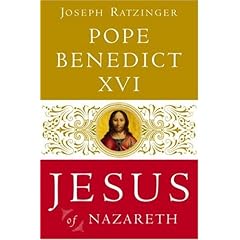 Of course, everyone should read the book by the Holy Father. It is not too technical for the popular reader. It is more 'technical' than Guardini's book, however. The Holy Father spends more time doing exegetical work especially philology (word studies). It is a fantastic book to counterbalance all the garbage people see on the Heresy (History) Channel about the Gospels.
 The Synopsis of the Four Gospels is a must for anyone trying to understand the Gospels more deeply. It puts all four Gospels side-by-side in columns so you can directly compare what each of them says. It is really amazing!
Spiritual reading of this sort is always the compliment to prayer. One must know about Jesus (so we can enter into the Truth) as one knows Jesus through prayer. It has to be both. Without the knowledge we easily fall into misconceptions, and you can't love what you do not know. If we do not know him in prayer, then the faith becomes a philosophy of living rather than an encounter with a person (cf. Deus Caritas Est #1).
Subscribe to:
Posts (Atom)
